Challenges for a New Futures Trader

Thanks for your post Jeff.
We all quit or almost quit during our trading careers. Although there may be several different reasons why, there is an old wall street saying that comes to mind here: “You never leave the Market - the Market leaves you…”

Stay the course, keep patient and prepare for what you do when the market’s randomness throws you a curve ball for a few days/weeks and your winning rate comes down to 40-50%. Be prepared and run some tests and be prepared.

I know traders who win only 33-40% of the time on average and still keep pulling money out of the markets on a consistent basis.

Happy trading,

  • Project11
5 Likes

@Jeff I appreciate that you shared it with the community. I hope to reply shortly addressing your issues, and a world of gratitude for saying such nice things about Optimus Futures. In the meantime, I hope others will jump to give their feedback.

Matt Z
Optimus Futures

2 Likes

@jeff, I hope the below response helps you out. Some of the things apply to all new traders.

If you ask any driver, he will tell you that he is better than the average driver.
In reality, they are not. My point: no one evaluates himself right because we don’t like giving ourselves a negative score after all.

I feel the same about traders as well. From demo to real-life trading, not too many “score” themselves right.
When you are in paper trading, you are in the state of “I don’t know” when you move to the actual trading, you are in the form of “learning.” When you gather stats about your strategy, observe your psychology and other variables such as the number of Futures contracts you trade, the hours you do best, distractions, etc.
Therefore, it is vital to be focused and analyze those factors that are important. If you don’t know what you follow, then everything becomes a random act.

It is important not to overwhelm ourselves and make sure we dedicate our time to one factor at a time. I think you have switched to a risk management mode, watching the length of trades, your trades’ frequency, and the time you stay in any given trade. These are all positive things!

When new traders switch from a demo mode to a real mode, almost everyone overtrades. It is only natural that you think more trades provide more opportunity, and with time, you will learn that it is not the case. You have to be selective and be patient with your trade setup. Overconfidence is rampant when new traders get off the demo mode. Like I said, “better driver” syndrome.

As for all the technical setups, backup, etc., I will let @Mod-JakeM handle that; he is excellent at it.

I hope this helps.

Thanks,
Matt Z
Optimus Futures

4 Likes

@Jeff first off, props for being so transparent and open with your trading. It’s hard to open up about the challenges we all face, but it’s important because everyone else has experienced the same and if they haven’t, they will.

I like the idea of keeping this as a trade journal.

When it comes to hearing about being in the money, then having it go against you. Or just simply getting stopped out, I’m curious about the average length of trade you enter? What time frames are you trading off of typically?

One thing I have struggled with is knowing when you exit the trade and also be objective about how the trade might be changing or exiting early (this one is super challenging to swallow for me).

Right now I’m trying to focus on baby steps, like 6 ticks a day. While it may seem small, the liquidity is there for scaling up quickly if there’s consistency happening with results.

3 Likes

Thanks Matt. I definitely feel like I a in learning mode right now. I look at this as my education costs. Either it costs me a little bit if I have to reload or it costs me nothing if I am able to trade my way out of this. Either way I find I really do enjoy the challenge that trading the futures provides. I need challenges in my life to keep me interested.
I have spoken with Jake about the technical issues. They definitely are not on your end. That leaves my slow connection or the motive wave platform as the culprits. Since complaining to Motive wave, the issues haven’t repeated themselves. Although they claim it isn’t on their end I know my connection speed hasn’t changed. My work around is to just not trade super high volume periods.

4 Likes

@Jeff Great post, I’ve definitely experienced many of the things that you’re describing. I’ve come to believe that the frustration and discomfort associated with learning to trade is a significant part of the developmental process (“school of hard knocks”). It is necessary to feel the pain of mistakes so that we learn from them and become less likely to make them again. In some ways it’s as if the market (I’m personifying it a bit) uses operant conditioning to train traders who are willing to stick with it for long enough to develop better habits. Of course there will be times when we do everything right and still lose, but if we recurrently do reasonable things (good entries, correct stops, sufficient targets for the risk, adequate probability, etc.) then the odds are in our favor over time.

I recommend using measured move projections like leg 1 = leg 2, measured moves based on the height of a trading range or the height of a breakout, that sort of thing if you don’t use them already. By having an idea of where the market may wind up going based on what has already happened it’s a bit more straight-forward to evaluate the strength of the move towards it.

5 Likes

Glad to see that perspective coming from you. When you are a beginner you gather stats, and that is the price you pay. The key is to make each session productive, and a learning lesson.
While many focus on their mistakes and go into a deep dive on these errors, try to learn as equally as much when you have good days. Then repeat that pattern again and again. Get your good habits more frequent in your trading.

You are more than welcome to switch or trade side by side with Optimus Flow.
It is free.

Matt Z
Optimus Futures

3 Likes

Hey Ben, Thank you for the reply. I’ve actually read a couple of your posts and need to read more. Good stuff. :). Over the coming weeks and months I will be reading a lot more and participating on this forum more as well.
I’m transparent with my stuff because I feel like I read someones posts sometimes and can’t figure out if they are trading a 2 dollar a point contract or 200 20 dollar a point contracts. I figure I would at least put some perspective on this and let others decide if they want to scale up.
At this point I am faced with only trading 1 micro on the MNQ. As everyone is probably aware, the NQ can move either way 100-300 points a day. There’s plenty of movement for me to get back to even and then profitability if I trade correctly and mange risk correctly.

Now to answer your questions.
I typically trade the 5 minute bars, At 1st I was just trying to scalp 5-10 points at a time with 1 NQ contract. 20 dollars a point. I don’t want to talk to much about what I did at first other than to point out that just about everything was a mistake on my part. Not managing risk, not waiting for the right entry points and just over trading like crazy…
As for the average length of my trades… It really does vary. I think the Monday before last I was in one trade for 7 minutes. A new record for me. :). Also a very good trade. I made 25 points and it was a great start to the day… I also made 2 more trades that day for a total of 25 more points or 50 points total for the day. So I made 100 bucks on a 650 dollar account. I finished the week at 800 so it was a good week for me. Anyway, that first trade was held for around 7 minutes. The next 2 were shorter scalps with the goal of just reaching 100 dollar profit.
The next day I entered 1 trade. The goal was only to make 1.5% or about 12 dollars after commission. I got a good entry and put a stop in 3 points below entry. It went up 5 points, just missed my target and then pulled back and stopped me out… That was the only trade I made that day… I then traded 2 more days last week and made money both days to end the week at 800 dollars.
I do struggle with the same things you do which is why I mostly scalp to grab my small percentages. Over the weekend II will try and grab some charts and put some notes on them. I’ll get them posted here for discussion. I think it’s easier to look at a chart with reference points drawn on it to have this discussion.
I will sometimes exit the trades early. At break even or a small gain or loss. You had mentioned getting a feel for the way things are going by staring at the DOM… You mentioned that in one of Matts podcasts I think… I do the same thing and your correct. You do get a feel for how the market is acting at the time. If it looks like my trade is hitting resistance I get out. Yes many times I have gotten out only to have that trade take off and run 20 or 30 points very quickly… grrrrrr. LOL.

I definitely look forward to discussing this more when I get some charts put up…

In regards to your last comment on the 6 ticks a day. IIRC your trading the ES correct? So 12.50 a tick? If your goal is 6 ticks whats your risk management? 2 ticks? I think many traders go for a 3 to 1 ratio on risk reward. For me. I risk 3-5 points because my account is so small now. My goal is 9-15 points. Baby steps for me as well since I almost blew my account up. LOL. Like you I just want consistent results before I scale up again.
My plan is for the next 6 months, study, analyze myself and get back to even or even profitability. I do think it I very possible and I say that because I have had many days where I started off horrible and down anywhere from 50-150 dollars and was able to trade my way back to anywhere from a small loss to a small gain… So for me, the difference between being a winning trader and losing trader is proper risk management.
I will hopefully get more things posted along with some charts this weekend. Probably go into more detail on many things as well.
Sorry I missed the podcast this week Matt. I look forward to the video though.

4 Likes

Thanks Matt. I have actually been speaking with Jake about getting set up with Optimus Flow. Bought a new computer last weekend and tomorrow should be contacting him to get switched over. It’s really the platform I wanted to use in the beginning but because I am on a Mac couldn’t do it… A very expensive lesson learned. :).
The new laptop I bought didn’t have an ethernet port so I had to buy an adapter that should be here in the morning. I’m really excited about getting this set up and very thankful to you for picking me as the winner last week.

4 Likes

Thank you trader. Glad you enjoyed the post. Looking back to the beginning, if there is one thing I wish I had done right, it would be risk management. Cant stress that enough… I think most can overcome anything in trading as long as the proper risk management is in place. If I had used proper risk management from the start I would probably be a profitable trader already.
Futures trading is also vastly different than trading stocks. Stocks move up or down 2-10% at most on most days… Futures you can be up or down that much in seconds LOL.

4 Likes

Good point. A losing trade does not mean you did not follow your plan, and again, some beginners struggle with that. They think that a winning trade must occur if a trader followed his plan. It’s all about the consistency of the execution.

I used to rank my trades by scoring them from 1-10 based on how closely I followed my plan. It was not related to+ or - results; rather, the focus was on setup, follow-through, and execution. There were times I gave myself a score of 1 on a winning trade because it was either impulsive, or worse, a double down, or some other knee-jerk fear and greed motivation. After scoring your trades, you see a pattern that luck does not exist for a long time, bad execution of a plan leads to losses, and the trades you follow through with complete rules such as the one I bolded below, show much more promising stats.

Matt Z
Optimus Futures

4 Likes

Excellent post, it reminds me of a video that an Olympic gold medalist rifle shooter made about being process-oriented and putting in the correct level of mental effort:

Similar to you, he talked about scoring himself on his quality of execution rather than focusing on the outcome and the impact that doing so had on his performance.

4 Likes

@Trader thank you for the tip! That goes back to not getting sucked into the short term effects of price action and order flow.

I need to sit back and look at the bigger picture.

3 Likes

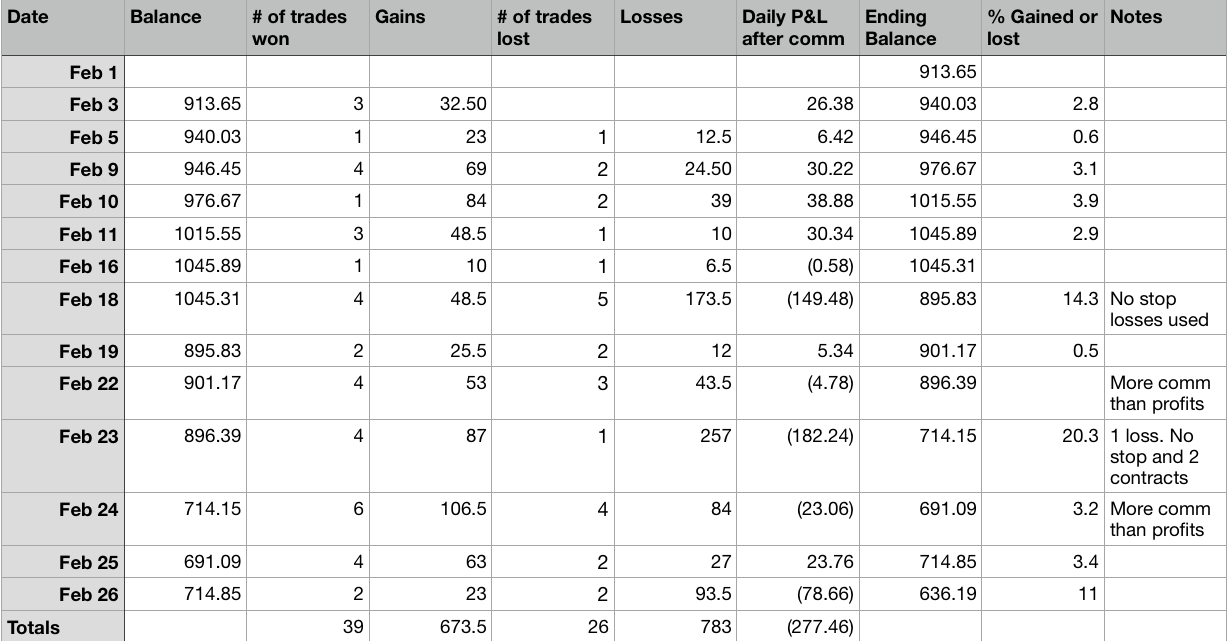
I spent some time last night and today putting together a spreadsheet with my trades from Feb and March. I know Matt had suggested analyzing our trades and after putting this together I can see why. It has been very helpful to do this exercise and I will definitely continue this. I now also know why he started the thread asking us to keep trac of how we felt when we made a trade… As I went through some of my trades I was like WTF was I thinking. LOL. If I had kept notes I would know exactly what I was thinking at the time.

ok so 1st I just want to say that for me, this isn’t about the size of my account. The purpose of all of this is to use this experience to become a trader. I want to get rid of the bad habits and establish good habits. That doesn’t happen in one session or even one month. It takes time. For me anyway.
So lets look at Feb. I can see the in the beginning of the months I was really trying to use my stop to limit losses. It was working well. Getting stopped out at 6-12 dollar losses was fine and I was able to make money in every session. Anywhere from 1/2 a percent up to about 4 percent per day.
On Feb 10th I know exactly what happened. I started out with a great trade. up 42 points and feeling on top of the world… Next 2 trades I traded without a stop for almost a 10 point loss per trade. If I had limited those losses to 10 or 12 dollars (5 or 6 points) The day would have looked even better on paper…
Lets look at Feb 18th. 4 winning trades and 5 losing trades… No stop losses and I really let this losers run… I did it again on the 23rd. Feeling very confident I went for 2 contracts and really let them run… How different would that day look with 1 loss of 2 contracts with a 6 point stop loss? The loss then becomes 25 dollars instead of 257.
Soo did I learn my lesson yet? Well, if we go to the 26th we will see that I did not. 2 losses on the day for 93 dollars instead of 20-25… What should have been a break even day tuns into an 11% loss on the account because of poor risk management. Without those 2 large losses for the month my account looks way different at the end of the month. About 30% different in fact.

Ok so for the month we have 6 days of losses. Of those 6, 3 of them are actually wins but commissions exceeded my profits. Since the P&L shows them as losses, that how I will treat them… So for the month 42% of my days were losers and 57% were winners. 39 winning trades and 26 losing. On a percentage basis 60% of my trades were wins and 40% losses for Feb.
So my takeaway for feb is that up until the 16th my trading looks pretty good. stop losses are in place and losses kept to a minimum. If we don’t look at commissions and just look at trading gains I actually gained 11 out of 14 days for a win rate of 78%… So, having just 3 bad days turns my account from a profit for the month to a loss… Easily avoidable with proper risk management.

Will I learn my lesson going forward? LOL. It’s going to be embarrassing to kill my March by doing the same thing.

So, lets look at March thus far. So far looking pretty good. 4 out of 5 trading days are wins and the one loss I was stopped out with a 6 dollar loss. That was 1 of my 2 traing losses for the month so far. The other being on the 11th. 1 losing trade for a 30 dollar loss. I still hit my goals for the day but again, that should have been a 6-12 dollar loss max. Just as in poker, every mistake is a leak. Same goes for trading. Every mistake, no matter how small is a mistake that lowers the value of your account.

I didn’t trade last week so looking at the few days I did trade. I booked a decent profit and just quit for the day. 2-7% on the day is ahead of my goal of 1.5%. Feeling good bout the month so far.
I do want to talk about March 8th. On paper it looks awesome. 14% gain. Biggest gain in the last 2 months. 3 winning trades. 1st one for more than 25 points. Last one was only for 5 points to get me over 100 dollar win for the day.
So, as I said, it looks good on paper. Let me explain how that day really went. It was early in the session. Everything seemed to be running smooth so I took a trade. market was moving fast to the upside so I felt a quick scalp was in order. Entered the trade but no trade confirmation. I’m thinking it must have went through. It was a limit order and the market come down below the order and then moved back up. Still, no tone when you get the trade confirmation… Market moves up then turns around and starts moving down. I can’t remember for sure but about 20-40 seconds later I get the tone that the trade went through. (Yea this is one of those glitch days) On the platform I was using the P&L for the trade is also right there in a column in the DOM. So I see now I am down 120 dollars or so… Then 160 and 182 So I set a stop loss at minus 200. Almost 1/3rd of my account… I figure it’s early in the day. It’s only 200 dollars and the market moves fast in both directions this early in the day. I’m trading the 5 minute bar and all of a sudden the last minute in the bar it decides to run up… 10-15 seconds left in the bar and I am only down 10.00. I almost sold right there but then said WTH, I was willing to lose 200, lets see if this thing runs the other direction when the next bar starts. So the next bar starts and it’s stalled right around my break even point. Could go either way but only thing to do is wait and see. Then it starts moving up slowly at first and by 2 minutes into the next bar I am up over 25 points. I book my profits and count my blessings. :). However, when I closed that trade the trade confirmation also doesn’t show up… Did it miss my trade or blow through it? Trading down now so profits are dwindling so I hit the sell side again. I then get 2 confirmations. One is my 1st trade did in fact go though and I booked my profit. the 2nd is now a short position also in the money right now so I close that and book that 30 dollar + profit as well. Now I am up 89 dollars so I just sit and wait and make sure there is nothing else open for a couple minutes… All is well so I close out, happy that I survived another glitch but this time to the upside. Later in the day I log back in looking for a quick scalp to top the 100 dollar mark. I got it and finished the day.
So, that 100 profit looks so easy on paper but the story behind it is much different. LOL.
There’s not much else to say about march so far… My goal for the rest of the month is to just get back about 900. That will get me back up to where my account was at the beginning of Feb.

On Friday Jake help me get set up with Optimus flow so I am very excited to start trading with that next week. So far I really like the platform. Very intuitive and very easy to use.

So I have to ask, is it helpful for me to put these spreadsheets in? Is there any interest in seeing my progress in this and keeping this going as a running blog? I figure I will only post the spreadsheets once a month at the beginning of the month…
I don’t know if this is helpful to new traders or if it is even the correct way to be looking at things. I think it is helpful to me because, although I knew my main leak with not using stop losses, I didn’t know exactly how much it affected my account… I do now.
Also if there is anything else I should be lookin at in regards to the spreadsheet, let me know and I can add other columns going forward.
I hope everyone has a great weekend.

4 Likes

Keeping track and having accountability is vital. A few things that may help you:

  1. Put a “Trade” in your excel as the number of decision-making you make. Yes, one trade is long and short, but it has two sides of buy and sell. In essence, it is two trades, entry and exit. This would help you understand the frequency of the trades you do.
  2. Just like in your first post, you are focused on $$ and less on the process. You keeping talking about where you want the account to be, you made X and Y on specific trades, and how you reacted to these amounts. It would be best if you stopped focusing on each trade’s micro and your reaction to it and having more of an aerial and topographical view of your trades.

We have zero control over where our balance would be at the end of the month. It is not a goal. It is Greed.
Saying I want X dollars at the end of the month will not help you get further; in fact, it will discourage you if you don’t achieve it. By the way, many traders have a problem with the word greed as if it’s a sin. Greed is when you decide how much you want to earn on a given day, month, and year. Not your choice. Greed is also a subtle feeling because we are humans, not because we are bad people. The market is not a machine you can set financial goals with unless you want to receive a certain amount like dividends. But, that is a different asset class. I digress.

Focus in your journal on Trigger, Setup, and Follow through. You see the signal forming, you get the setup, and you execute—that way, you are building structure.

If you stray from the structure, you decrease the odds of success, increase the odds of making a mistake, and increase emotional response chances.

Following that, you can build a statistical performance that is 100% rule-based. If the results are not according to plan, you can start tweaking one small change at a time.

I hope the trade journal we are building will help you as well.

Keep tracking, digging, and sharing.

Matt Z
Optimus Futures

Ps. Thank for switching to Optimus Flow. Feel free to ask about features and provide feedback here:

3 Likes

Great advice. As I was doing this spreadsheet I was thinking I need to make a journal with more information on each trade… Then I come onto the forum looking for ideas and I see your developing a journal which I will be very interested in. :).

Ok I think I understand what you mean here. I know as I was putting together this spreadsheet, except for a few trades, I had no idea why I entered a trade or why I got out. Since many of those were just scalps I just assume I was watching the DOM and saw an opportunity… I also realize I see a lot of set up I don’t take. I watch them to see if they would work and most of the time they would. However, I really need to note those in a journal as well so that I can have confidence in taking them. I look at this all as the progression of hopefully becoming a trader one day. :).

2 Likes

So for example if I am going long in a trade put a 1 and if short put a 2? Should I also put time stamps and price entered and exited? I had thought about doing that just so I can see where I went right or wrong on the charts. I could really analyze each trade a lot more by having that information.

2 Likes

Yes, make two trades when for each entry and exit. It is not wrong to do 1 for a trade, but ding two helps to conceptualize the number of times you click. Again, this is a personal preference and helps me because small details can make a difference in my decision-making in general.

Timestampscould is a good addition. The idea is to measure your P&L in terms of time, from setup to exit. Sometimes traders would stay in a trade longer than they should while market conditions have completely changed. The price does not have to hit your profit or loss to exit; sometimes, it is time. For example, if you trade a 15 min chart, you should not be in a trade for three hours. This is my opinion. I discussed that in one of the webinars that you could do a 1:3 ratio for your trades: for example, a 15-minute chart would let you be in a trade for 45 minutes max, a 5-minute chart for 15 min, etc. If you stay in a trade longer than you should, you start to hope instead of looking for new setups.

Leveraged trading is a different state of mind and, above all, different management of trades. It is not an investment. In investing time may work in your favor; in leveraged trading, it is not.
The only time you practice is waiting patiently for your setups.

You have to trust that you will develop your own set of tools to measure and evaluate your trades with time. Above all, use the KISS process so you don’t go from trade analysis to trade paralysis.

Matt Z
Optimus Futures

4 Likes

Thank you, I find your webinars extremely helpful with nuggets of information like this. It seem so obvious once pointed out, yet easy to be blind to something so obvious until pointed out.

3 Likes

The challenge in anything that involves psychology is to create awareness of our conscious and always automated (due to DNA) decisions. I believe that this is also part of the challenge in trading.
As individuals, we work opposite to crowd behavior and that is also the challenge of trading.
You are trading against a group, and you must be aware of your actions. If you are not, you will act against your own best interests.

The good news is that the minute you are aware, you change, well, at least I hope that some will change.

Let me use an example: Let’s talk about a common mistake that beginner traders do and it’s adding $$ to losing positions. Now, let’s say you tell a beginner “You will be inclined to add money to losing positions, but don’t. Here is why: It is proven statistically that 87% of the time, most prices will continue against you if you act in such manner” Now you made a fact conscious and that may alter the behavior of the trader. This is of course one example out of many that we need to be aware and my goal through this forum and discussion to bring to light as many perspectives and thoughts as possible.
It’s a world of difference when you know the facts that affect our behavior.

Matt Z
Optimus Futures

3 Likes