Hey Ben, I really appreciate the fact that you recorded and posted your trading session! If you don’t mind, I’ll write a bit of unsolicited feedback on some things I noticed (I watched the first 51 minutes of “Trading session 4/7/21 Wednesday”):
- The first trade was a short late after a strong sell off. The overall context up to that point made it more likely that that was a bear leg in a trading range (strong bull leg up earlier in the session and within the prior session’s range) rather than the start of a new bear trend, so selling low is relatively risky. Looking at the few bars leading into that entry: the third to last bear bar on the sell off had a very prominent tail below (bears likely covering and bulls starting to buy more aggressively). The next bar was a very large bear bar which in this context is more likely a sell vacuum test of the lows and sell climax (climax doesn’t necessarily mean it’ll lead to a reversal) rather than a measuring gap into a new bear trend (this bar also had a lot of overlap with the bar before it and bears who sold too low were likely going to use that bar an an opportunity to cover). The follow through bar was a doji (a 1 bar trading range) with only a small bear body which is disappointing follow through for any bears who sold low on the large bear trend bar. There’s a saying, “big up, big down, big confusion” and confusion is a hallmark of a trading range, so it’s better to be looking to buy in the lower portion of the range and sell in the upper portion of the range. Prior to the short entry that was taken, the bar had a prominent tail below that went through the lowest close so any bears who did want to get out of their shorts at breakeven, aside from those who entered at the bottom tick or two, would have been able to do so. Limit order bulls would be looking to buy in the same area which adds to the buying pressure. Those few bars also constituted a higher low micro double bottom (it went down and up with the bear bars followed by the two bull bars and then went down and up on the bar that you entered on) and technically entering above that bull bar is a second entry long which tends to be reasonably high probability in this context. Given the larger trading range and overall bullishness of the market taking a short low in the range is actually a contrarian stance despite the recent sell off. In this sort of context, the market will tend to try to test to at least the top of the sell climax bar.
- Notice how when the market did wind up selling off again, it formed large bear trend bars with very poor follow through (large bull trend bars), so again bears and bulls were buying the lows rather than having the bears continuing to be interested in shorting the lows. There were other signs in the price action as it unfolded, but this is becoming another long post so I’ll refrain from commenting too much on other things. Many of the things that I talked about above came into play again.
- I think you may be looking at too many things. If it helps you, then keep doing it, but I’ve noticed in my own trading that when I look at too many things it leads to decision fatigue, paralysis by analysis, and cognitive overload which subsequently causes errors in my decision making. I noticed that at times you added more indicators and studies while sitting in a position that was moving against you which may be a sign that you’re looking to confirm a bias towards the position that you’re currently in. This potential bias could also be seen in the way that the trend lines and channels were being drawn.
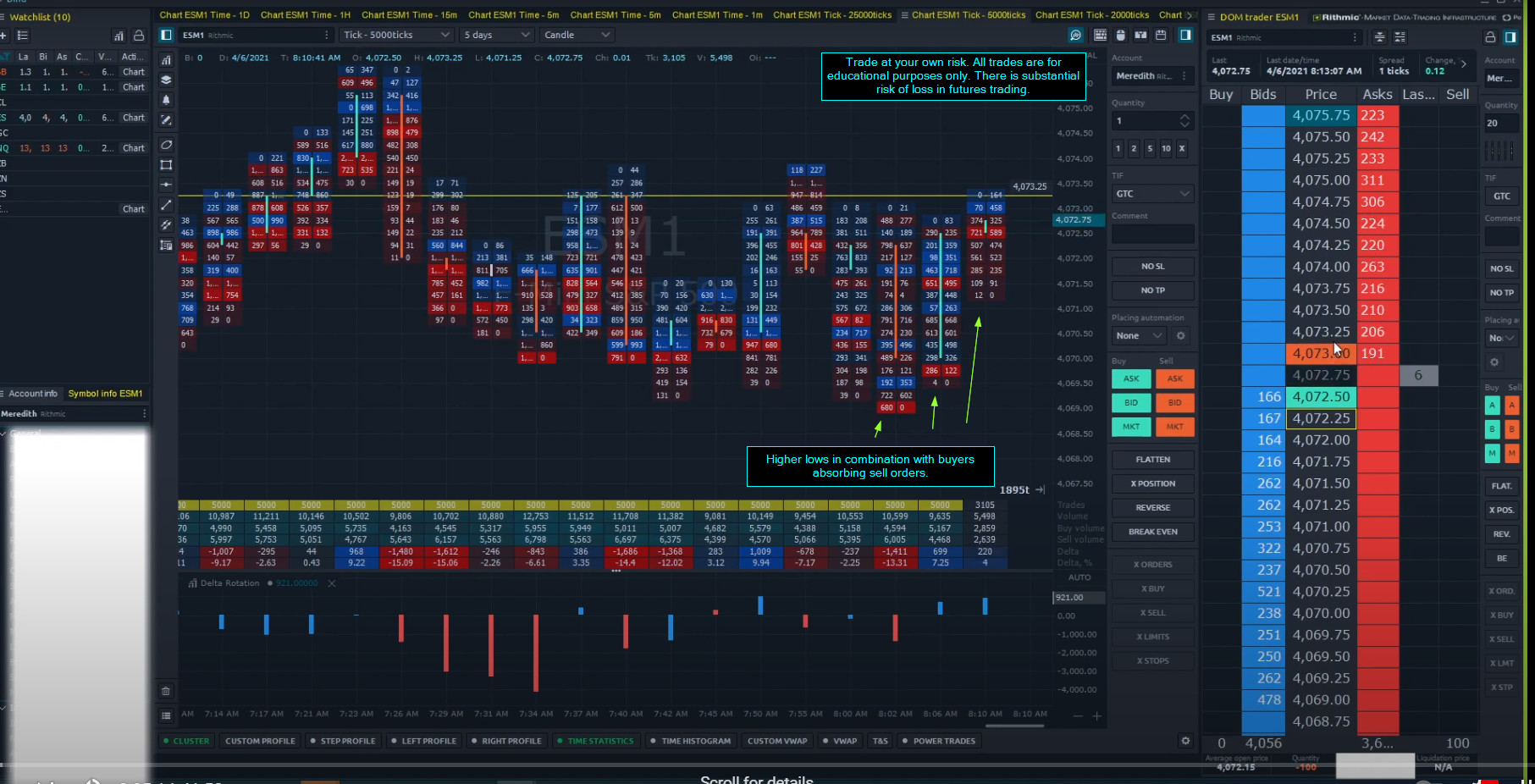
- Speaking of information overload, it’s worth noting that there was buy side absorption before the short that was taken around 34 minutes into the video. This could be seen on the lower portion of the footprint chart around 35:10 (and on the heat map, but it was harder to see), then the buyers stepped up and held the market higher between 4062.75 and 4064.00. I’m guessing you noticed that too which is why you got out of the trade. I think there would be less of a temptation to reverse from long to short and vice versa if less information is considered. It becomes easier to miss things (particularly the overall context when order flow is watched too closely) when too much information is viewed.